Twelve months ago, AI search referral traffic was a rounding error. Today it represents 12–18% of total web referral traffic globally, growing at 200% year-on-year. And the visitors it sends convert at 4.4x the rate of organic search.
Most UK small businesses don't know this traffic exists. Their analytics don't break it out. Their SEO agencies aren't tracking it. And their websites are almost certainly not optimised for it.
That's a problem — because the gap between businesses that understand AI search and those that don't is widening fast.
The Numbers That Should Be Getting More Attention
Let's start with the scale of what's happening.
ChatGPT alone accounts for 87% of all AI referral traffic. It processes hundreds of millions of queries per week, many of them directly replacing searches people used to do on Google. Perplexity AI has grown its user base to 45 million active users, with 800% year-on-year growth. Combined, these platforms are actively sending visitors to websites — and those visitors arrive with intent that's already refined.
Citation capsule: AI-powered search engines account for an estimated 12–18% of total web referral traffic as of early 2026, up from 5–8% in late 2024. ChatGPT visitors convert 4.4x higher than organic search traffic. Brands investing in GEO report 30–40% higher AI referral traffic compared to those relying solely on traditional SEO. (Sources: upGrowth AI Traffic Share Report 2026; Position Digital AI SEO Statistics 2026)
The conversion rate difference deserves particular attention. When someone arrives at your website from ChatGPT, they've typically had a more thorough research process than a Google user. ChatGPT gave them context, cited specific sources (including you), and they clicked through because they already have a positive impression. That's a fundamentally different buying signal.
Why Most UK Businesses Are Missing This
The problem is structural.
Traditional SEO is optimised for Google's link graph and keyword index. The tools, the metrics, the KPIs — all of it is built around appearing in the ten blue links. AI search doesn't work that way. There are no paid rankings, no domain authority scores that directly translate, no keyword density games.
AI search engines work by building a comprehensive answer from multiple sources and citing the most relevant, credible, and clearly-written ones. If your content isn't cited, you don't exist in that answer. You can rank on page one of Google and still be completely absent from ChatGPT's response about your industry. Our guide to what GEO (Generative Engine Optimisation) actually is explains the mechanics in detail.
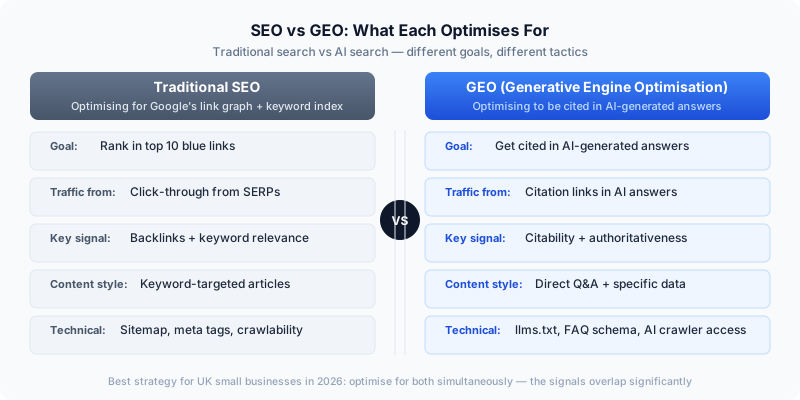
For UK small businesses, this creates a real asymmetry. Large brands with well-known names get mentioned in AI responses simply because they're well-known. SMEs need to earn citations through content quality, structured data, and genuine expertise signals.
The good news: this is learnable. And unlike traditional SEO, which rewards domain age and link volume, AI citation readiness is achievable relatively quickly if you do the right things.
What AI Search Engines Are Actually Looking For
ChatGPT, Perplexity, and Google's AI Overviews all have different architectures, but they share a common need: they want content they can cite with confidence.
That means content that:
States facts clearly and precisely. AI models extract specific claims to build their answers. Vague language ("we help businesses grow") gets ignored. Specific claims ("UK SMEs lose an average of 23% of potential organic traffic due to missing schema markup") get cited.
Has identifiable authorship. AI systems increasingly weight content from named, credentialled sources over anonymous pages. Your author bio, your LinkedIn profile, your professional credentials — these contribute to whether AI systems trust your content enough to cite it.
Answers questions directly. Perplexity and ChatGPT are fundamentally question-answering systems. If your content doesn't directly answer the questions your customers are asking, it doesn't fit what these systems are looking for.
Is technically accessible. GPTBot (ChatGPT's crawler), PerplexityBot, and GoogleOther (AI Overviews) all need to be able to access and index your content. Blocking them in your robots.txt — which a surprisingly large number of UK sites do accidentally — means you can't appear in their responses at all.
The Opportunity Gap for UK Small Businesses
Here's where the opportunity sits: most UK SME websites are not optimised for AI citation at all. The structural things that make content citable — clear question-and-answer formatting, specific data points, authoritative authorship signals, FAQ schema, accessible robots.txt — are missing from the vast majority.
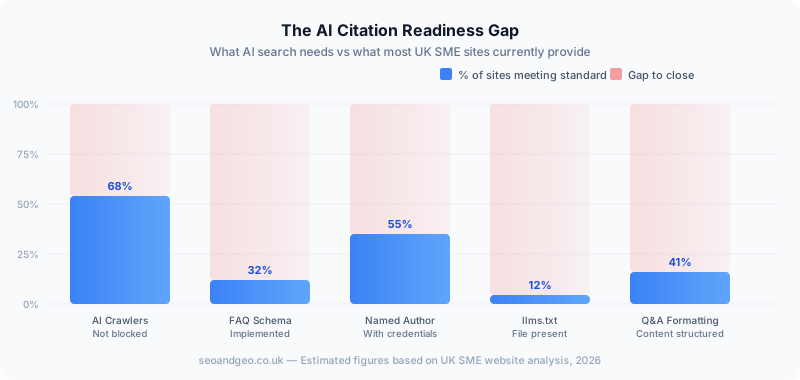
This means that if you do the work, you're not competing against brands with five years of authority building. You're competing against a gap in the market that most businesses haven't noticed yet.
The window won't stay open indefinitely. As more agencies start offering "GEO services" (generative engine optimisation), the competition for AI citations will increase. The businesses that build their AI visibility now will be better positioned to maintain it when the market catches up.
What to Actually Do About It
A few concrete starting points:
1. Check your robots.txt. Visit yourdomain.co.uk/robots.txt. If you see User-agent: GPTBot or User-agent: PerplexityBot followed by Disallow: /, you're blocking AI crawlers. Fix that immediately. For the full step-by-step process, read our guide on checking whether your website is visible to ChatGPT.
2. Add FAQ schema to your key pages. FAQ schema gives AI systems a directly structured question-and-answer format to extract from. It's one of the highest-leverage technical changes you can make for AI search visibility.
3. Add an llms.txt file. This is an emerging standard that tells AI systems what your site is about and which content is most important. Think of it as a sitemap for AI.
4. Reframe your content as answers. Go through your top pages and ask: if someone asked this question to ChatGPT, would our page be a good answer? If not, rewrite it so it is.
5. Get your AI visibility audited properly. Understanding exactly which AI crawlers can access your site, what your citability score looks like, and what specific changes will improve your AI search presence requires a technical audit. We cover all of this across 200+ checks in our full digital visibility audit.
If you want to know where you currently stand, run your audit at seoandgeo.co.uk/audit. The AI search section alone covers crawler access, llms.txt, schema quality, citability scoring, and platform-specific optimisation for ChatGPT, Perplexity, and Google AI Overviews.
FAQ
Do I need to choose between SEO and GEO, or can I do both?
Both, and the two are increasingly interlinked. The March 2026 Google core update makes this explicit: the content signals that win traditional rankings (original research, expert authorship, clear answers) are the same signals that win AI citations. Good content strategy serves both. Where they diverge is in technical optimisation — things like llms.txt, AI crawler access, and FAQ schema are GEO-specific.
Will AI search traffic replace Google traffic, or add to it?
The evidence so far suggests it's additive rather than replacement, particularly for purchase intent queries. Google handles broad discovery; AI search handles more specific, research-heavy queries. A customer might Google "accountants near me" but ask ChatGPT "which accounting software is best for a UK freelancer and why". You want to appear in both.
How do I track AI search traffic in my analytics?
In Google Analytics 4, AI referral traffic from ChatGPT appears as direct traffic by default (because ChatGPT uses a no-referrer header). You can segment it by creating a custom channel grouping for chat.openai.com and chatgpt.com. Perplexity referrals appear under perplexity.ai. This is an area where most businesses are flying blind — the traffic exists but isn't being attributed correctly.
Free Audit
Want to see how your site scores?
Run a combined SEO + GEO audit. 200+ checks, platform-specific fixes, and a free re-audit at 90 days to measure your progress.
Get Your Free Audit Score