What Is GEO? A Small Business Guide to AI Search Optimisation
GEO stands for Generative Engine Optimisation. It is the practice of optimising your website and online presence so that AI search engines — ChatGPT, Perplexity, Google AI Overviews, Microsoft Copilot, and Gemini — cite and recommend your business when people ask them questions.
If you run a small business in the UK, here is why this matters right now: 78% of companies are already funding GEO programmes, yet only 23% are actually measuring the results. That gap between action and measurement represents a massive opportunity — and a serious risk if you do nothing.
Your website might rank well on Google. But when a potential customer asks ChatGPT "Who is the best accountant in Leeds?" or "Which café in Brighton has the best coffee?", does your business come up? For most small businesses, the honest answer is no. GEO is how you change that.
This guide explains what GEO is, why it matters for UK small businesses, how it differs from traditional SEO, and exactly what you can do about it — starting today.
TL;DR: GEO (Generative Engine Optimisation) gets your business cited by AI search engines like ChatGPT and Perplexity. The GEO market is projected to reach $7.3 billion by 2031. AI visitors convert at 4.4x the rate of organic traffic, but AI answers cite only 2-7 sources — making citation slots fiercely competitive.
What Is GEO? The Plain-English Definition
Generative Engine Optimisation (GEO) is a new discipline focused on making your content visible to AI-powered search tools. Where traditional SEO helps you rank in Google's list of blue links, GEO helps you get cited inside the AI-generated answers that are rapidly replacing those blue links.
Here is a simple way to think about it:
- SEO = getting your website found on Google
- GEO = getting your business cited and recommended by AI
When someone types a question into ChatGPT, Perplexity, or Google's AI Overview panel, the AI does not simply list ten websites. It reads dozens of sources, synthesises the information, and delivers a single, conversational answer — often citing just two to seven sources. GEO is about making sure your business is one of those cited sources.
The term "generative engine" refers to AI systems that generate answers rather than simply listing links. These engines include:
- ChatGPT (OpenAI) — now handling approximately 17% of global search queries
- Perplexity — a dedicated AI search engine growing over 200% year-on-year
- Google AI Overviews — Google's own AI summaries appearing in at least 16% of all searches
- Microsoft Copilot — integrated into Bing and Microsoft 365
- Gemini — Google's standalone AI assistant
Each of these platforms pulls information from the web, but they each do it differently. Some favour fresh content. Some prioritise structured data. Some rely heavily on brand mentions across multiple sources. GEO is about understanding these differences and optimising for all of them.
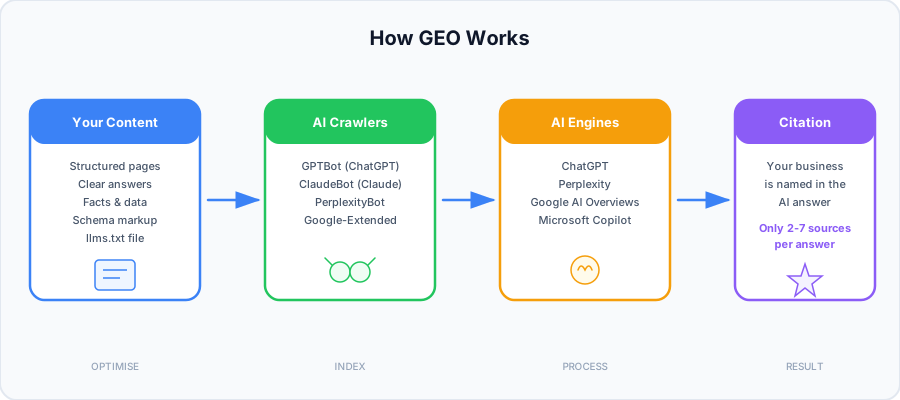
Key point: Generative Engine Optimisation (GEO) is the practice of optimising content so AI search engines cite your business. Unlike SEO, which targets Google's blue links, GEO targets AI-generated answers from ChatGPT, Perplexity, and Google AI Overviews — platforms that cite just two to seven sources per answer.
Why Does GEO Matter for Small Businesses?
You might be thinking: "This sounds like something for big companies. Does it really affect my plumbing firm or my bakery?"
Yes. And here is the data that explains why.
AI Search Is Growing Faster Than Anything Else in Digital Marketing
The GEO services market was valued at $848 million to $1 billion in 2025. By 2031, it is projected to reach $7.3 billion — a compound annual growth rate of 34%. That is not speculation; it reflects the speed at which consumers are switching from traditional search to AI-powered discovery.
AI-referred website sessions grew 527% year-on-year in the first half of 2025, and the growth has continued into 2026. Gartner predicts that traditional search volume will drop 25% by the end of 2026 as AI search absorbs more and more queries.
Fewer Clicks, but Higher Quality
Here is where it gets interesting for small businesses. 93% of Google AI Mode sessions now end without the user clicking through to a website. That sounds alarming — but the visitors who do click through from AI answers convert at 4.4 times the rate of standard organic traffic.
AI search is not about getting more clicks. It is about getting the right clicks from people who have already been told by an AI that your business is worth visiting.
Your Competitors Are Already Investing
The Clutch 2025 study (n=600 companies) found that 78% of businesses are already funding GEO initiatives. But only 23% are investing in GEO measurement. This creates two opportunities for your business:
- If you start now, you are ahead of the 22% who have not begun at all
- If you measure your GEO performance, you are ahead of the 77% who are spending money without tracking whether it works
The Citation Economy Is Ruthlessly Competitive
Unlike Google, which displays ten results per page, AI search engines typically cite just two to seven sources per answer. That means the competition for those citation slots is far more intense. If your business is not structured for AI discovery, you simply will not appear — there is no page two to fall back on.
Key point: The GEO services market grew from $848 million in 2025 to a projected $7.3 billion by 2031, reflecting a 34% compound annual growth rate. AI-referred website sessions grew 527% year-on-year, while visitors from AI answers convert at 4.4 times the rate of standard organic traffic.
How Does GEO Differ from SEO?
GEO and SEO are not competing strategies — they are complementary. You need both. But they work differently, and understanding those differences is essential.
| SEO | GEO | |
|---|---|---|
| Goal | Rank in search engine results pages | Get cited in AI-generated answers |
| Success metric | Position #1 for target keywords | Being one of 2–7 cited sources |
| Optimise for | Google's ranking algorithm | AI retrieval and summarisation systems |
| Key signals | Backlinks, keywords, page speed, technical health | Content structure, brand mentions, entity authority, AI crawler access |
| Content focus | Keyword-optimised pages | Citable, structured, fact-dense content |
| Update frequency | Periodic refreshes | Every 60 days minimum (pages updated within 60 days are 1.9x more likely to appear in AI answers) |
| Competition | 10 slots per results page | 2–7 citation slots per AI answer |
The critical point: traditional SEO remains the foundation. If your content is not indexed by Google, AI tools cannot find it either. But good SEO alone is no longer enough. The overlap between Google rankings and AI citations has dropped from 70% to below 20% — meaning a page can rank #1 on Google and still be invisible to ChatGPT.
No tool currently combines deep SEO analysis with comprehensive GEO auditing in a single report. That is exactly why we built seoandgeo.co.uk — to give small businesses both scores in one place.
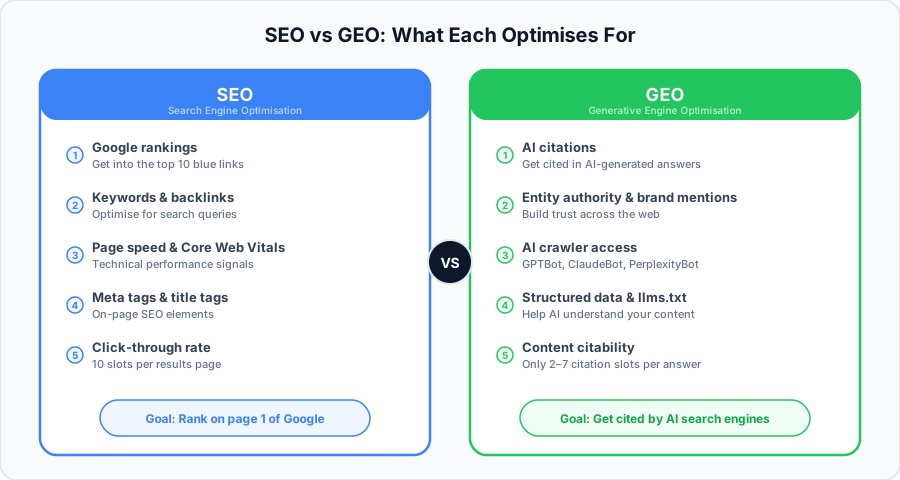
Key point: The overlap between Google rankings and AI citations has dropped from 70% to below 20%. A page can rank first on Google and remain invisible to ChatGPT. SEO targets ten results-page slots; GEO competes for just two to seven citation slots per AI-generated answer.
What Are the 5 Key Elements of GEO?
If GEO is the discipline, what does it actually involve? Here are the five elements that determine whether AI search engines can find, understand, and cite your business.
1. AI Citability Scoring
AI citability measures how easily an AI engine can extract useful, quotable information from your content. This is not about keywords — it is about structure and specificity.
Content that scores well for AI citability typically has:
- Clear, direct answers in the first 200 words (44.2% of ChatGPT citations come from the first 30% of content)
- Specific data points — original statistics, pricing, measurements, and facts that AI can quote directly
- Structured formatting — H2/H3 headings, bullet points, comparison tables, and FAQ sections that make information easy to extract
- Definitive statements — AI prefers content that states facts clearly rather than hedging with "it depends"
2. AI Crawler Access
Just as Google uses Googlebot to crawl your website, AI platforms use their own crawlers:
- GPTBot — OpenAI's crawler for ChatGPT
- ClaudeBot — Anthropic's crawler for Claude
- PerplexityBot — Perplexity's web crawler
If your website blocks these crawlers (intentionally or accidentally), AI search engines cannot read your content and will never cite you. We cover this in detail in our step-by-step guide on how to check whether your website is visible to ChatGPT. Currently, 35.7% of the top 1,000 websites block GPTBot — a 7x increase since launch. Many of those sites are large publishers with specific commercial reasons. For a small business, blocking AI crawlers is almost always counterproductive.
Your robots.txt file controls which crawlers can access your site. If you have never heard of this file, there is a good chance your site either has no AI crawler directives at all (meaning access defaults to allowed) or is inadvertently blocking them.
3. llms.txt Compliance
llms.txt is a relatively new file — think of it as robots.txt for AI. Where robots.txt tells search engine crawlers what they can and cannot access, llms.txt provides AI systems with a structured summary of what your website is about, what your business does, and what content is most important.
Most websites do not have an llms.txt file yet. Adding one is a straightforward way to help AI engines understand and correctly represent your business. Our Comprehensive audit generates a tailored llms.txt file for your site.
4. Brand Mention Signals
This is perhaps the most important — and most underappreciated — element of GEO. AI search engines do not just read your website. They synthesise information from across the entire web. If your brand is mentioned consistently across forums, review sites, industry directories, and social media, AI engines treat you as a known, trustworthy entity.
Research from AI search optimisation communities consistently shows that brand entity presence across multiple sources is the single most important factor for AI search visibility — more important than any on-page optimisation.
This is particularly relevant for small businesses. A local plumber who is active on community forums, has consistent Google Business Profile information, and gets mentioned in local directories will be cited by AI far more often than one with a perfectly optimised website but no broader web presence.
5. Platform-Specific Optimisation
Each AI search platform has different citation patterns, data sources, and preferences. ChatGPT and Perplexity, for example, handle citations very differently:
- Perplexity cites sources explicitly and drives trackable referral traffic
- ChatGPT often synthesises without clear attribution, making brand recognition more important
- Google AI Overviews draws heavily from pages that already rank well organically
A proper GEO strategy does not treat all AI platforms the same. It optimises for each one based on its specific retrieval patterns.
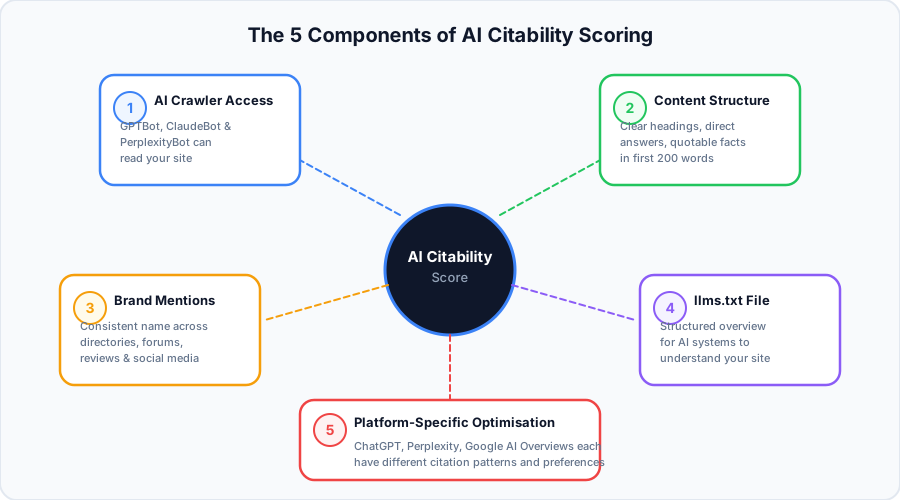
Key point: Five elements drive GEO success: AI citability scoring, AI crawler access, llms.txt compliance, brand mention signals, and platform-specific optimisation. Research shows 44.2% of ChatGPT citations come from the first 30% of page content, and 35.7% of the top 1,000 websites currently block GPTBot.
How to Check Your GEO Readiness: A Quick Checklist
You do not need an agency or expensive tools to start assessing your GEO readiness. Here are six checks you can do right now:
-
Ask ChatGPT about your business. Type your business name and location into ChatGPT. Does it know you exist? Is the information accurate? If ChatGPT returns nothing or gets facts wrong, you have a GEO problem.
-
Search for your services on Perplexity. Try queries your customers would use — "best [your service] in [your town]." Are you cited? Are your competitors?
-
Check your robots.txt file. Visit
yourwebsite.com/robots.txtin a browser. Look for directives mentioning GPTBot, ClaudeBot, or PerplexityBot. If they are set to "Disallow", AI crawlers cannot read your site. -
Review your content structure. Open your most important service page. Does it have clear headings (H2, H3)? Does the first paragraph directly answer what you do and who you serve? Are there specific, quotable facts?
-
Check content freshness. When was your website content last updated? If it has been more than 60 days, your AI visibility may have dropped by as much as 36%.
-
Search for your brand across the web. Google your business name in quotes. How many mentions appear beyond your own website? Are you on relevant directories, review sites, and forums?
Want to skip the manual checks? Our audit runs over 200 automated checks covering every element above — plus a full SEO analysis — in minutes.
What Does GEO Look Like in Practice for a UK Small Business?
To make this concrete, here is what GEO looks like in practice for three different types of UK small business:
A plumber in Manchester discovers that ChatGPT recommends three competitors but not them when asked "best emergency plumber in Manchester." After a GEO audit, they update their website's opening content to directly state their services, areas covered, and response times. They ensure GPTBot can access their site, add structured FAQ content, and become active on local community forums. Pages updated within 60 days are 1.9x more likely to appear in AI answers, and within that window ChatGPT starts including them in recommendations.
A café in Brighton finds that Perplexity cites TripAdvisor reviews and a local food blog when asked about "best coffee in Brighton" — but their own website is never mentioned. Their GEO audit reveals that their site is JavaScript-heavy (making it hard for AI crawlers to read), has no structured data, and their brand is inconsistent across directories. After fixing these issues and encouraging customer reviews that mention their brand by name, they start appearing in AI-generated local recommendations.
An accountancy firm in Leeds realises that when potential clients ask ChatGPT "best accountant for small business in Leeds", the AI recommends firms with active community presences and clear, structured service pages. Their GEO audit shows strong SEO but weak AI citability — their content uses vague language and lacks the specific, fact-dense structure AI prefers. After restructuring their service pages and publishing data-rich guides, they earn a citation slot.
These are not hypothetical outcomes. They reflect the documented patterns of how AI search engines select and cite sources.
Key point: A UK small business can improve AI citations within 60 days by restructuring content for AI extractability, ensuring GPTBot and PerplexityBot can access the site, adding structured FAQ content, and building consistent brand mentions across local directories and community forums.
Frequently Asked Questions
Is GEO replacing SEO?
No. GEO and SEO work together. Traditional SEO ensures your site is indexed and ranks well on Google — this remains essential because AI tools often use Google's index as a starting point for retrieval. GEO adds a layer on top, ensuring that AI search engines can also find, understand, and cite your content. Think of it as SEO + GEO, not SEO vs GEO. For a deeper comparison, read our guide on SEO vs GEO: what UK small businesses need to know in 2026.
How much does GEO cost?
It varies widely. Enterprise GEO tools and agencies charge anywhere from $250 to $5,000 per month. For UK small businesses, there are more affordable options. Our combined SEO + GEO audits start at £49 for an Essential report, with Professional (£97) and Comprehensive (£197) tiers for businesses that want deeper analysis and platform-specific recommendations.
How long does GEO take to show results?
Two timelines matter. For on-site changes (content restructuring, AI crawler access, llms.txt), you can see improvements in AI citations within 60 days — that is the window AI engines use for freshness scoring. For broader entity building (brand mentions, community presence, review signals), expect three to six months of consistent effort before you see meaningful shifts in AI visibility.
Can I do GEO myself?
Yes, the basics are absolutely doable. The checklist in this article is a solid starting point. Where most small business owners get stuck is knowing which specific issues to fix first and how each AI platform evaluates their site differently. That is where a structured audit helps — it tells you exactly where you stand and what to prioritise.
What AI search platforms should I worry about?
Focus on the five that matter most for UK businesses: ChatGPT, Perplexity, Google AI Overviews, Microsoft Copilot, and Gemini. Each has a different share of AI search traffic and different citation patterns. ChatGPT holds 55–60% of AI-native referral share, Perplexity accounts for 18–22%, and Google AI Overviews are integrated into standard Google searches. A comprehensive GEO strategy covers all of them.
Is GEO just a buzzword?
The community is genuinely divided on this. Some practitioners argue that GEO is simply "good SEO evolving." Others see it as a distinct discipline with its own tools, metrics, and strategies. The reality is somewhere in between: the fundamentals overlap with good SEO, but AI search introduces new signals (AI crawler access, llms.txt, entity authority, citation patterns) that traditional SEO does not address. Whether you call it GEO or "the next evolution of SEO," the underlying shift is real and measurable.
What Are the Key Takeaways?
- GEO (Generative Engine Optimisation) is the practice of optimising your content so AI search engines cite and recommend your business
- AI search is growing rapidly — the GEO market is projected to reach $7.3 billion by 2031, and ChatGPT now handles 17% of global search queries
- AI visitors are more valuable — they convert at 4.4x the rate of standard organic traffic, but competition for citation slots is fierce (only 2–7 sources cited per AI answer)
- GEO and SEO are complementary, not competing — you need both, and no tool combined them until now
- Five elements drive GEO success: AI citability scoring, AI crawler access, llms.txt compliance, brand mention signals, and platform-specific optimisation
- Content freshness is critical — update your key pages every 60 days to maintain AI visibility
- You can start today — use the checklist above to assess your GEO readiness, or run an automated audit for the full picture
See How Visible Your Business Is to AI Search
You have read the guide. You understand what GEO is and why it matters. Now the question is: where does your business actually stand?
Run a free GEO + SEO audit on your website to see how visible you are to AI search engines. Our audit combines deep SEO analysis with comprehensive GEO checks — AI citability scoring, AI crawler access, llms.txt compliance, brand mention signals, and platform-specific optimisation — all in one report.
It takes less than two minutes to start, and you will get your Digital Visibility Score immediately.
Free Audit
Want to see how your site scores?
Run a combined SEO + GEO audit. 200+ checks, platform-specific fixes, and a free re-audit at 90 days to measure your progress.
Get Your Free Audit Score